What Justin Ishbia's White Sox Plan Means for Chicago Real Estate
Short answer: On September 5, 2026, incoming White Sox owner Justin Ishbia unveiled "The Railyards" — a proposal to convert more than 80 acres of South Loop rail property into a ballpark district anchored by a 35,000-to-38,000-seat stadium, with Northwestern Medicine facilities, housing and retail. It is a proposal, not an approved project, and Ishbia does not yet control the team. But if it advances, it would create a continuous stadium corridor along the Chicago River and reshape values in the South Loop, Pilsen and Bridgeport.
First, the part almost everyone is getting wrong
Justin Ishbia cannot move the White Sox right now. That matters more than any rendering.
Under the ownership agreement announced in 2025, Jerry Reinsdorf remains the controlling owner and the sole day-to-day decision-maker. Reinsdorf may sell controlling interest to Ishbia between 2029 and 2033. Ishbia's own option to acquire control doesn't arrive until after the 2034 season. Ishbia has been making capital infusions as a limited partner in the meantime.
Separately, the Sox lease at Rate Field expires after the 2029 season.
So there are two different clocks running — the lease clock and the ownership clock — and they don't line up. Ishbia is assembling a site and a financing structure years before he'd have the authority to relocate the team. That's a sophisticated real estate play, and it's also why "the Sox are moving to the South Loop" is not yet a true statement.
What is The Railyards?
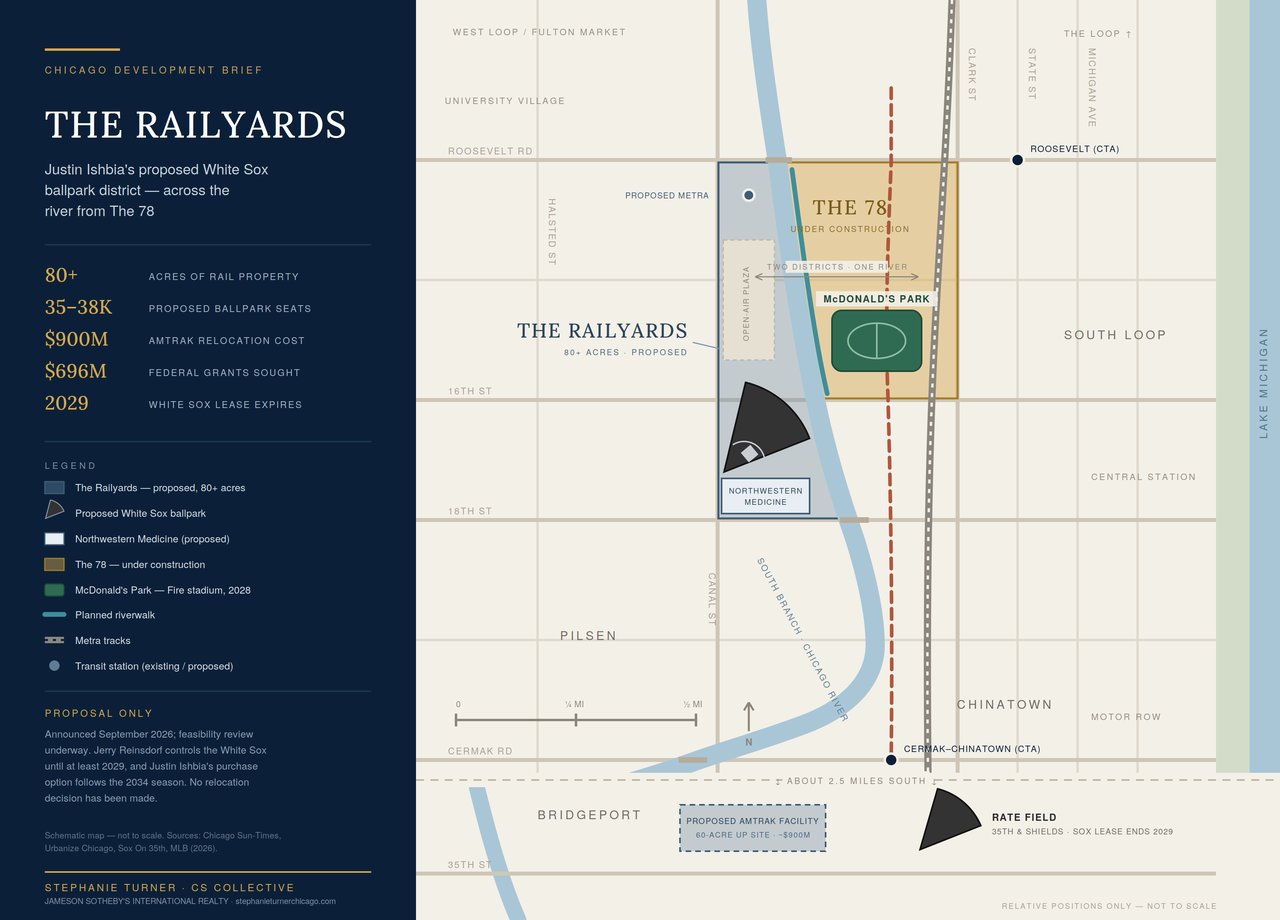
Site | Rail property from Roosevelt Road to 18th Street, along the South Branch of the Chicago River, west of the river and east of Canal Street |
Size | 80+ acres of rail property, including the roughly 47-acre Amtrak coach yard |
Ballpark | 35,000–38,000 seats, open-air, right field along the river, plaza extending north to Roosevelt |
Other uses | Northwestern Medicine facilities, residential, retail and dining, open space, a potential new Metra station, bridges over the rail lines |
Land control | Canal Edge LLC, an Ishbia entity, has the property under contract |
Design | AECOM |
Status | Early-stage feasibility work on transportation and environmental impacts |
The enabling step is the hard part: Amtrak's coach yard has to move. The plan calls for a roughly $900 million replacement facility on a 60-acre Union Pacific property in Bridgeport, near Rate Field, on an 18-month construction timeline that could begin in fall 2026. The financing stack includes $125 million-plus from Ishbia personally, $696 million in federal transportation grants, and a pursuit of $1.8 billion in low-interest federal railroad loans.
The detail that changes the map
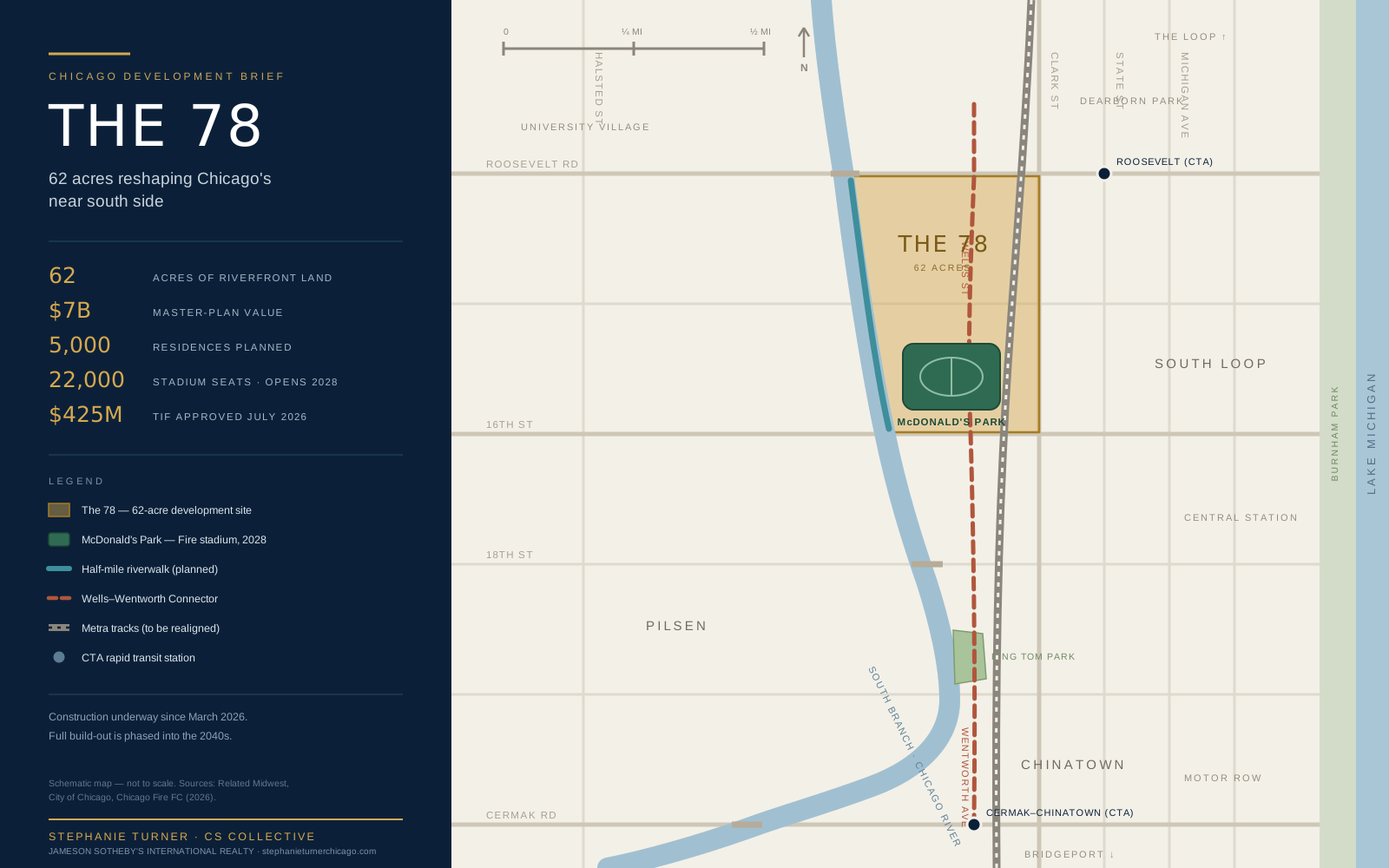
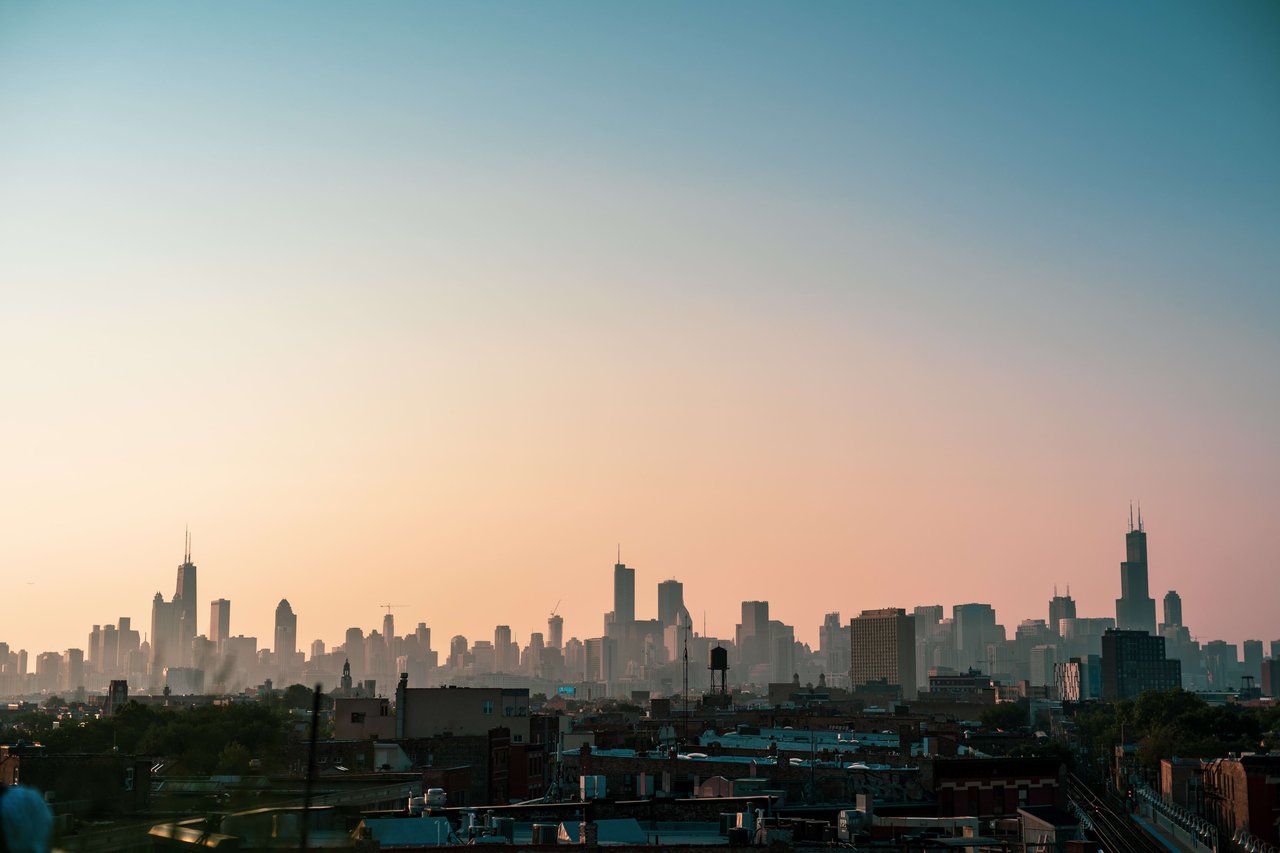
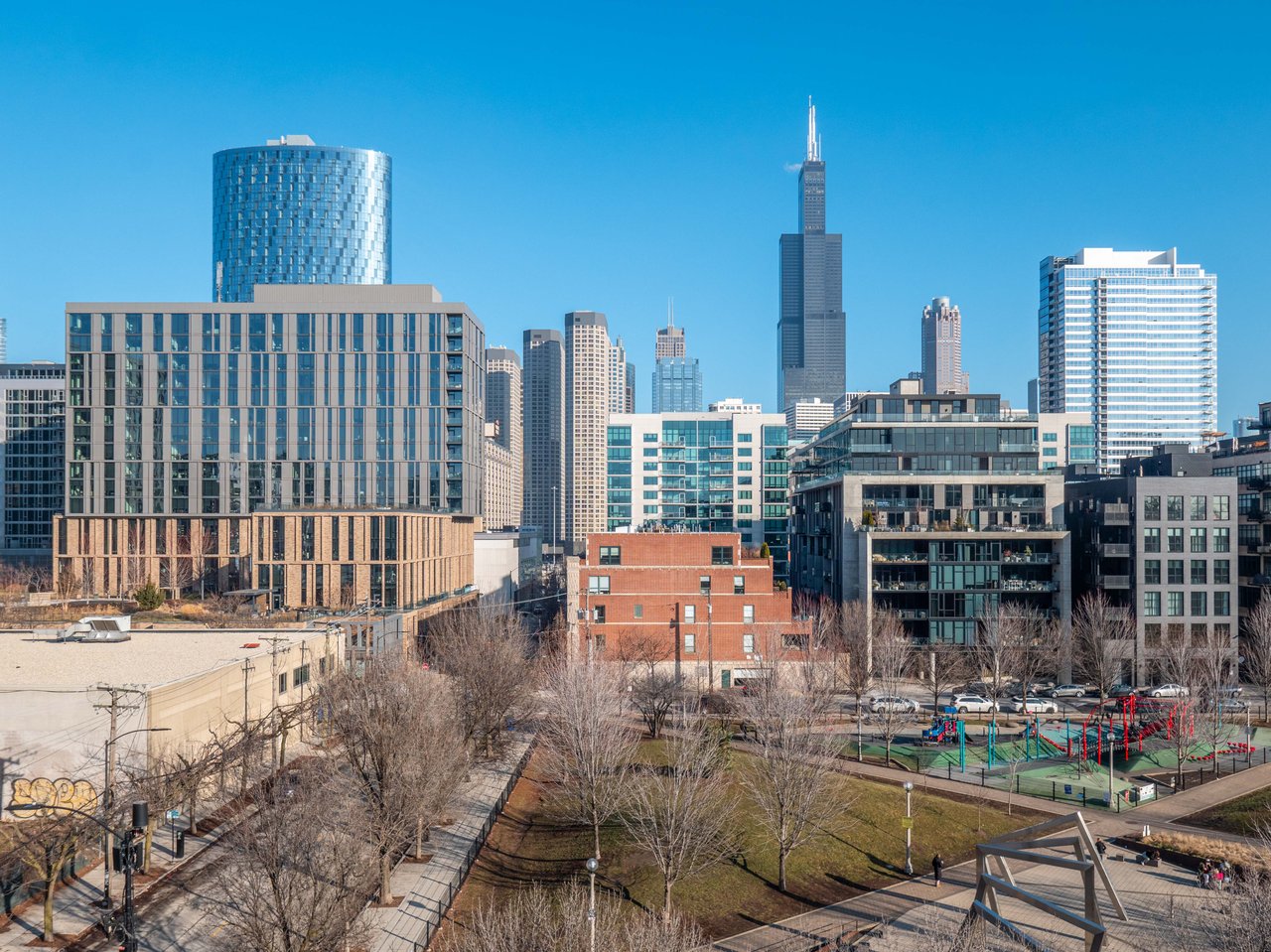
The Railyards sits on the west bank of the river. The 78 — where the Chicago Fire's McDonald's Park is already under construction — sits on the east bank, directly across the water, between Roosevelt and 16th.
If both are built, Chicago gets two stadiums facing each other across a half-mile of river, plus roughly 150 combined acres of new district between Roosevelt and 18th Street. That is a fundamentally different proposition than either project alone. It's the difference between an amenity and a destination.
Everything between them — the river corridor, the Roosevelt Road bridge, the eastern edge of Pilsen, the northern edge of Chinatown — becomes the connective tissue. That's where I'd be paying attention.
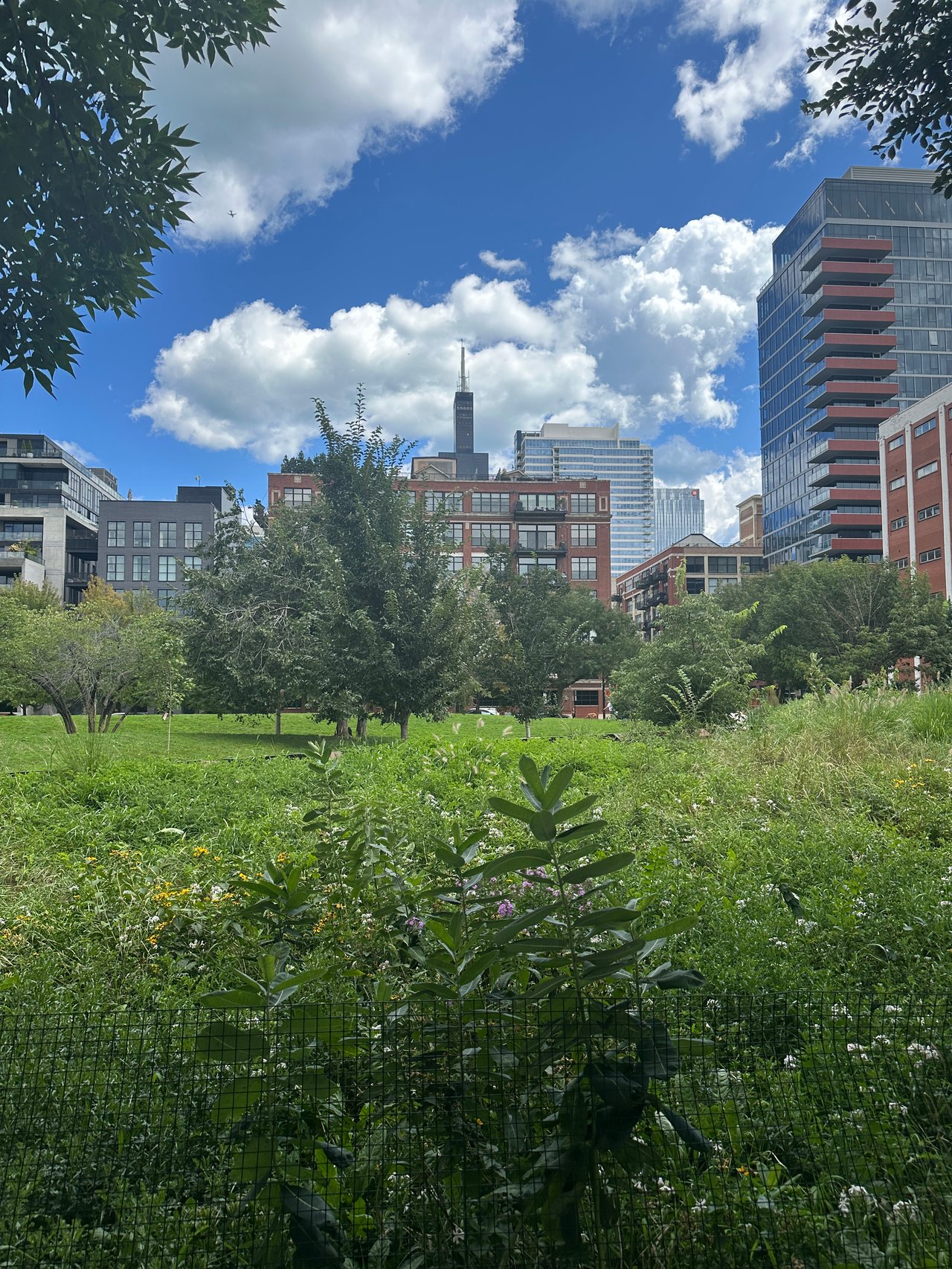
What it means for the South Loop
The South Loop is already absorbing one stadium district. A second would compound the effect, particularly for the blocks between Roosevelt and 18th.
Where the market sits now (Redfin, June 2026):
- Median sale price: $394,863, down 4.0% year-over-year
- Price per square foot: $329, up 1.9%
- Median days on market: 55
- Sale-to-list ratio: 102%, with 53.3% of homes selling above list
Soft median, firming price per foot. That gap is the entry window, and it exists precisely because the neighborhood's upside is still speculative rather than delivered.
What it means for Bridgeport and Armour Square
This is the most underdiscussed piece, and it cuts both ways.
The downside case: Bridgeport has had the White Sox for 116 years. Cook County Commissioner John Daley and 11th Ward Alderman Nicole Lee called the proposal "nothing less than a betrayal to the community." Losing an anchor institution is a real risk to the restaurant and bar economy along 35th Street.
The offsetting case: the plan brings a $900 million Amtrak maintenance facility to a 60-acre Bridgeport site — permanent jobs, permanent tax base. And if the Sox eventually leave 35th and Shields, that stadium parcel becomes one of the largest redevelopment opportunities on the South Side, with expressway frontage and a Red Line stop.
Bridgeport's market today (Redfin, August 2026): median sale price $499,759, down 8.3% year-over-year; $244 per square foot; 54 days on market; 102.6% sale-to-list. Note that Bridgeport's median sits above the South Loop's — a reflection of single-family stock versus condo stock, and a reminder that headline medians across neighborhoods aren't comparable.
If you own in Bridgeport, my read is that the next several years are a period of uncertainty, not decline. The Amtrak facility is closer to reality than the stadium departure.
The funding fight is live
Lee and Daley have said that "any request for tax breaks and TIF dollars in support of this plan should be roundly rejected." 28th Ward Alderman Jason Ervin has been more open, citing jobs and infrastructure.
The context matters: City Council approved $425 million in TIF for infrastructure at The 78 in July 2026, and that vote drew criticism. A second stadium district asking for public money in the same corridor, in the same term, is a harder sell. Ishbia has emphasized private and federal funding — watch whether that holds.
What has to happen before any of this is real
- Amtrak has to agree to relocate, and the replacement facility has to be financed and built.
- Federal grants and loans have to come through.
- Zoning and environmental review have to clear.
- Reinsdorf — or a future controlling owner — has to decide the team is leaving Bridgeport.
- The team's post-2029 lease situation has to be resolved.
Each of those is a genuine point of failure. I'd treat this as a credible, well-capitalized proposal at an early stage, not a done deal.
What buyers and sellers should actually do
If you're buying in the South Loop or East Pilsen: buy the property, not the rendering. Underwrite the unit on today's fundamentals — the building's reserves, its assessment history, its rental cap, your carrying cost after reassessment — and treat the stadium district as optionality you didn't pay for. A seven-to-ten-year horizon is realistic.
If you're selling in the South Loop: the story got materially stronger in September. Two funded or proposed stadium districts within a half mile is a narrative most competing listings aren't telling yet. It belongs in your marketing.
If you own in Bridgeport: don't sell on a headline. Nothing about the Sox's location changes before 2029 at the earliest, and the Amtrak facility is a genuine offsetting asset. If you were planning to sell in the next 12 to 18 months anyway, proceed normally.
If you're an investor: the corridor's land is already controlled by Related Midwest and Canal Edge, so the actionable play is existing product. Buy for scarcity rather than proximity — view lines that can't be built out, floorplans new construction won't replicate, parking, and associations with clean reserves and no rental cap. The inventory to avoid is commodity one-bedroom stock, which is precisely what several thousand new units will compete against.
One more Ishbia file worth knowing about — on the North Shore
Ishbia is also the buyer behind one of the largest residential assemblages in recent North Shore history. Since 2020 he has acquired four Lake Michigan properties in Winnetka, three of them contiguous, for an estate that neighbors have estimated at around 68,000 square feet — a figure Ishbia has disputed, noting that residents are including basement space. The project has drawn significant local opposition over tree and bluff removal, and a 2022 land-swap arrangement with the village fell through.
I mention it because it's a useful signal about how this buyer operates: long horizons, quiet assemblage, and a willingness to absorb public friction. That's the same pattern showing up at The Railyards.
Frequently asked questions
Does Justin Ishbia own the Chicago White Sox?
Not yet. As of 2026 he is a limited partner. Jerry Reinsdorf remains the controlling owner and sole decision-maker. Reinsdorf may sell control to Ishbia between 2029 and 2033, and Ishbia holds an option to acquire control after the 2034 season.
Where would the new White Sox stadium be built?
The Railyards proposal would place a 35,000-to-38,000-seat ballpark on rail property between Roosevelt Road and 18th Street, west of the South Branch of the Chicago River and east of Canal Street in the South Loop.
Is the White Sox stadium at The Railyards approved?
No. It is an early-stage proposal undergoing feasibility review. It depends on relocating Amtrak's coach yard to Bridgeport, federal funding, city approvals, and a future decision by White Sox ownership.
What happens to Rate Field?
Nothing in the near term — the Sox lease runs through the 2029 season. If the team eventually relocates, the 35th and Shields site would become a major South Side redevelopment opportunity.
How would this affect South Loop home values?
Two stadium districts within a half mile would add significant amenity value over time, but the effect would arrive as infrastructure and retail actually deliver — realistically in the 2030s. South Loop's median sale price was $394,863 in June 2026, down 4.0% year-over-year.
Stephanie Turner is a Chicago real estate broker with 10 years in the market and co-leads CS Collective at Jameson Sotheby's International Realty, specializing in the West Loop, Fulton Market, Bucktown, Lincoln Park and Chicago's North Side, along with the North Shore suburbs. Weighing a move in the South Loop or Bridgeport? Call 312.523.3131 or email [email protected].